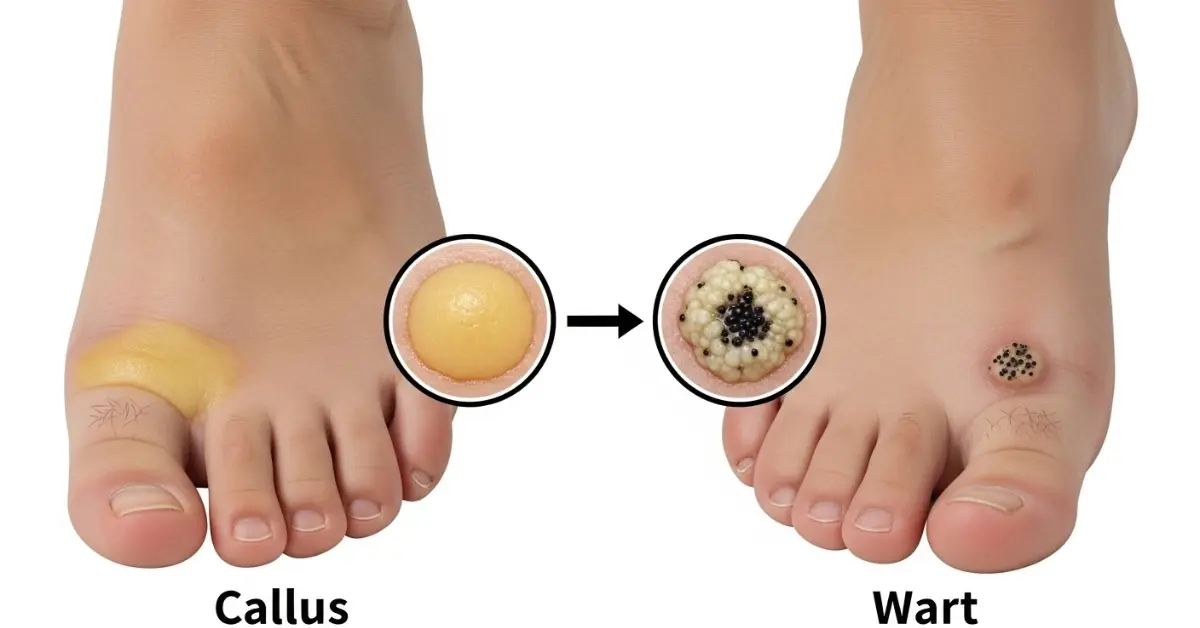
A girl who loved dancing noticed a hard patch on her foot. She thought it was a wart. At the same time, her brother had a small rough bump on his hand. He thought it was just thick skin. When they visited a doctor, they learned the difference between callus and wart. A callus forms because of repeated pressure or rubbing on the skin. A wart forms because of a virus infection.
Key Difference Between the Both
- Callus is thickened skin caused by friction or pressure.
- Wart is a small skin growth caused by a virus.
Why Is It Important to Know the Difference?
Knowing the difference helps:
- Students understand skin health.
- Athletes protect their feet.
- Parents treat children safely.
- Doctors give the correct medicine.
Using the wrong treatment can make the problem worse.
Pronunciation (US & UK)
- Callus
- US: /ˈkæləs/
- UK: /ˈkæləs/
- Wart
- US: /wɔːrt/
- UK: /wɔːt/
Let us now clearly understand the difference between callus and wart step by step.
Difference Between Callus and Wart
1. Cause
Callus: Caused by pressure or rubbing. Examples:
- Tight shoes
- Holding tools for long hours
Wart: Caused by a virus (Human Papillomavirus). Examples:
- Walking barefoot in public pools
- Direct skin contact
2. Appearance
Callus: Thick, flat, and hard area of skin. Examples:
- Heel
- Palm
Wart: Small, raised bump. Examples:
- Finger
- Sole of the foot
3. Pain
Callus: Usually painless. Examples:
- Hard skin on heel
- Slight discomfort
Wart: Can hurt when pressed. Examples:
- Plantar wart
- Wart under pressure
4. Contagious
Callus: Not contagious. Examples:
- Sports activity
- Writing for long hours
Wart: Contagious. Examples:
- Sharing towels
- Touching infected skin
5. Surface Texture
Callus: Smooth and thick. Examples:
- Even surface
- Yellowish color
Wart: Rough and grainy. Examples:
- Looks like cauliflower
- Small black dots inside
6. Growth Speed
Callus: Grows slowly with pressure. Examples:
- Runners
- Guitar players
Wart: Grows due to viral infection. Examples:
- Children’s hands
- Around nails
7. Skin Lines
Callus: Skin lines continue across it. Examples:
- Normal skin pattern
- Straight lines
Wart: Skin lines stop or break. Examples:
- Uneven center
- Rough area
8. Treatment
Callus: Soaking and moisturizing helps. Examples:
- Foot cream
- Pumice stone
Wart: Needs medicine or freezing treatment. Examples:
- Special ointment
- Doctor treatment
9. Location
Callus: Mostly on pressure points. Examples:
- Heels
- Hands
Wart: Can appear almost anywhere. Examples:
- Fingers
- Face
10. Prevention
Callus: Wear comfortable shoes and gloves. Examples:
- Sports shoes
- Work gloves
Wart: Avoid contact with infected skin. Examples:
- Do not share personal items
- Wear slippers in public showers
Nature and Behaviour
A callus is the body’s natural protection. It forms to protect skin from damage.
A wart is caused by a virus. It can spread to other parts of the body or to other people.
Why Do People Get Confused?
Both appear on hands and feet. Both can feel hard. Without close checking, they look similar.
Which Is Better in What Situation?
A callus is not harmful in most cases. It protects the skin from damage. For example, workers and athletes develop calluses that help them handle pressure. If it does not hurt, it may not need removal.
A wart should be treated carefully. Since it is caused by a virus, it can spread and become painful. Early treatment helps prevent infection and discomfort.
Metaphors and Similes
- “Callus heart” means someone who is unkind.
- “Warts and all” means accepting someone with all faults.
- “Hard as a callus.”
Connotative Meaning
Callus
- Negative: “Callus behavior” means cruel.
- Neutral: Thick skin protection.
Wart
- Negative: Small flaw or defect.
- Neutral: Skin growth.
Idioms
- Warts and all – accept everything, good and bad.
- “I love my friend, warts and all.”
(Callus is often used in phrases like “callus attitude.”)
Works in Literature
- The Wart (part of The Once and Future King) – Fantasy, T. H. White, 1958
Movies
- The Sword in the Stone – 1963, USA (based on the story of “The Wart”)
FAQs
1. Is a callus dangerous? No, unless it becomes painful.
2. Can a wart spread? Yes, it is contagious.
3. Should I cut a callus? No, soften it safely instead.
4. Do warts need a doctor? Sometimes, yes.
5. Can both appear on feet? Yes, both can appear on feet.
How Both Are Useful for Surroundings
A callus protects the body from injury. It is like natural armor for the skin.
A wart is not useful, but learning about it helps people stay clean and healthy.
Final Words
A callus protects. A wart infects. Knowing the difference keeps your skin safe.
Conclusion
The difference between callus and wart is simple to understand. A callus is thick skin caused by pressure. A wart is a small growth caused by a virus. A callus does not spread and usually does not hurt. A wart can spread and may cause pain.

I am a professional English article writer with expertise in creating clear, well-researched, and engaging content. I specialize in writing informative articles that maintain accuracy, strong structure, and a polished tone. My work reflects a deep understanding of grammar, vocabulary, and audience needs. I am committed to delivering high-quality content that communicates ideas effectively and adds value to readers.