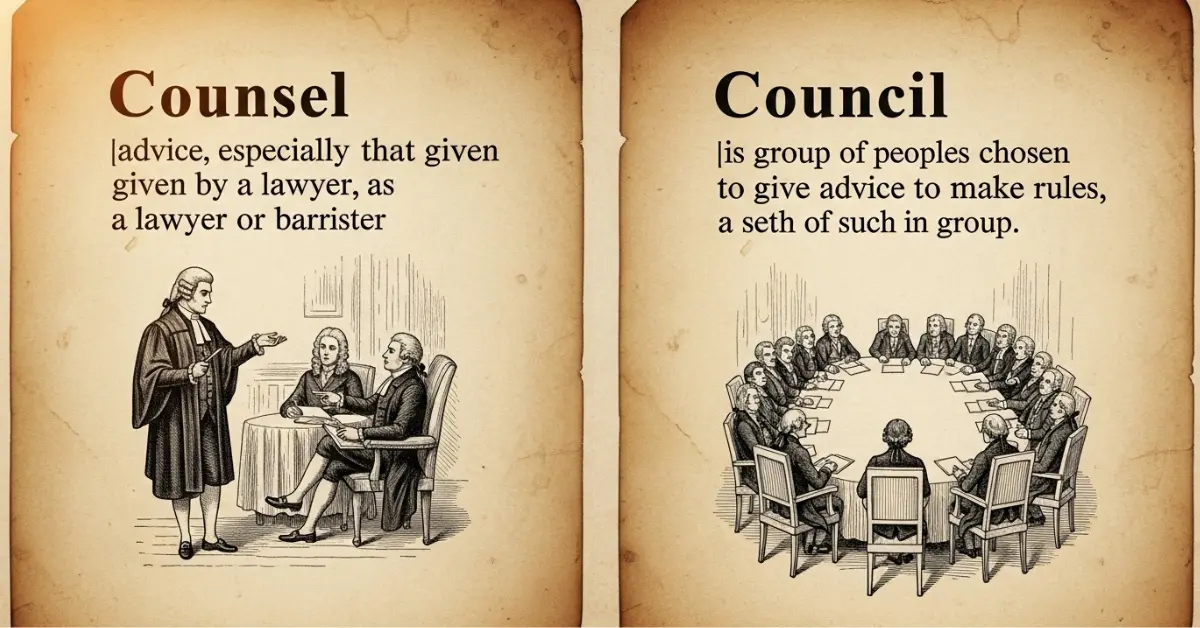
Last year, a friend of mine received a legal notice. He quickly went to a lawyer for counsel. On the same day, his town’s council met to discuss new parking rules. He later told me how confusing the two words sounded. This real-life moment perfectly explains the difference between counsel and council.
The word counsel means legal advice, or the lawyer who gives that advice. The word council means a group of people who meet to make decisions. Many learners mix them up in writing.
Key Difference Between the Both
The main difference between counsel and council is simple:
- Counsel = Advice or a lawyer who gives advice.
- Council = A group of people who meet to discuss or decide something.
One is about guidance. The other is about a decision-making group.
Why Is Their Difference Necessary to Know for Learners and Experts?
Counsel and council is important in offices and government institutions. A small spelling mistake can change the meaning of a sentence completely.
For learners, correct usage improves writing skills and exam performance.
Pronunciation (US & UK)
- Counsel
- US: /ˈkaʊn.səl/
- UK: /ˈkaʊn.səl/
- Council
- US: /ˈkaʊn.səl/
- UK: /ˈkaʊn.səl/
Both are pronounced the same, which is why confusion happens.
Let’s clearly explore how these two similar-sounding words differ in practical use.
Difference Between the Keywords
Here are 10 clear points explaining the difference between counsel and council:
1. Meaning
Counsel means advice or a lawyer.
- She sought counsel before signing the contract.
- The counsel spoke confidently in court.
Council means a decision-making group.
- The city council approved the budget.
- The student council organized the event.
2. Part of Speech
Counsel can be a noun or verb.
- He gave good counsel.
- The teacher counseled the student.
Council is only a noun.
- The council voted today.
- The council meets every month.
3. Usage Field
Counsel is mostly used in legal or advisory settings.
- She hired legal counsel.
- He sought medical counsel.
Council is used in government or organizations.
- The local council passed a law.
- The council discussed city planning.
4. Individual vs Group
Counsel can refer to one person.
- The defense counsel arrived late.
- My counsel advised patience.
Council always refers to a group.
- The council debated for hours.
- The council members voted together.
5. Function
Counsel gives advice.
- She offered wise counsel.
- He counseled her about career choices.
Council makes decisions.
- The council approved the project.
- The council rejected the proposal.
6. Legal Context
Counsel is common in court.
- Counsel for the defense presented evidence.
- The judge listened to counsel.
Council is rarely used in court.
- The council does not handle criminal trials.
- The council focuses on city matters.
7. Verb Form
Counsel can be a verb.
- She counseled him wisely.
- Doctors counsel patients.
Council has no verb form.
- Incorrect: He counseled me.
- Correct: He counseled me.
8. Spelling Pattern
Counsel ends with “-sel.”
- Good counsel is valuable.
- I trust her counsel.
Council ends with “-cil.”
- The council building is old.
- The council meeting lasted long.
9. Emotional Connection
Counsel often relates to personal guidance.
- She sought spiritual counsel.
- He needed financial counsel.
Council relates to public matters.
- The council addressed traffic issues.
- The council handled community complaints.
10. Scope
Counsel focuses on advice or representation.
- Legal counsel defended him.
- She offered helpful counsel.
The council focuses on governance.
- The council manages city services.
- The council controls local policies.
Nature and Behaviour
Counsel is advisory, supportive, and personal. It focuses on guidance and problem-solving.
Council is collective, authoritative, and administrative. It focuses on rules, policies, and decisions.
Why Are People Confused About Their Use?
People confuse them because:
- They sound exactly the same.
- Their spellings are very similar.
- Both relate to advice and decision-making in some way.
The identical pronunciation makes writing difficult for many learners.
Which Is Better in What Situation?
Counsel is better in situations involving legal matters, personal advice or professional guidance. If someone is facing a career problem, or personal crisis, seeking counsel is the right step. It ensures clarity, safety, and informed decisions.
Council is better when collective decision-making is needed. In community planning, school activities, or government matters, a council is necessary. It represents group authority and shared responsibility.
How the Keywords Are Used in Metaphors and Similes
- “Her counsel was a lighthouse in the storm.” (metaphor)
- “He followed her counsel like a student follows a teacher.” (simile)
- “The council became the backbone of the city.” (metaphor)
- “The council stood firm like a wall.” (simile)
Connotative Meaning
Counsel – Mostly positive (wisdom, guidance)
- Her counsel saved him from trouble.
Council – Neutral (authority, administration)
- The council announced new taxes.
Idioms or Proverbs
- “He who will not be counseled cannot be helped.”
- Example: He ignored advice; he who will not be counseled cannot be helped.
- “Take counsel of your fears.”
- Example: Before investing, take counsel of your fears.
(Council has fewer idioms directly linked to it.)
Works in Literature
- “The Counsel of Despair” – Short story by Sir Arthur Conan Doyle (1893, Mystery)
- “The Council of Elrond” – Chapter in The Lord of the Rings by J.R.R. Tolkien (1954, Fantasy)
Movies
- “The Council” (2021, USA)
- “The Devil’s Advocate” (1997, USA – legal counsel theme)
Five Frequently Asked Questions
1. Are counsel and council pronounced the same? Yes, both are pronounced /ˈkaʊn.səl/.
2. Can counsel be a verb? Yes, it means to give advice.
3. Is council ever used for one person? No, it refers to a group.
4. Which word is used in court? Counsel is used in court.
5. Why do students confuse them? Because they sound identical and have similar spelling.
How Both Are Useful for Surroundings
Counsel helps individuals make wise decisions and avoid mistakes. It supports justice and emotional well-being.
Council helps communities function smoothly. It manages public services, laws, and social order.
Final Words for Both
Counsel guides the individual. Council guides the community.
Both are essential in building a balanced and organized society.
Conclusion
The difference between counsel and council may seem small, but it is very important. While counsel relates to advice, council refers to a group that makes decisions. They sound identical, which causes confusion, but their meanings are completely different. Understanding this distinction improves writing accuracy and professional communication.

I am a professional English article writer with expertise in creating clear, well-researched, and engaging content. I specialize in writing informative articles that maintain accuracy, strong structure, and a polished tone. My work reflects a deep understanding of grammar, vocabulary, and audience needs. I am committed to delivering high-quality content that communicates ideas effectively and adds value to readers.