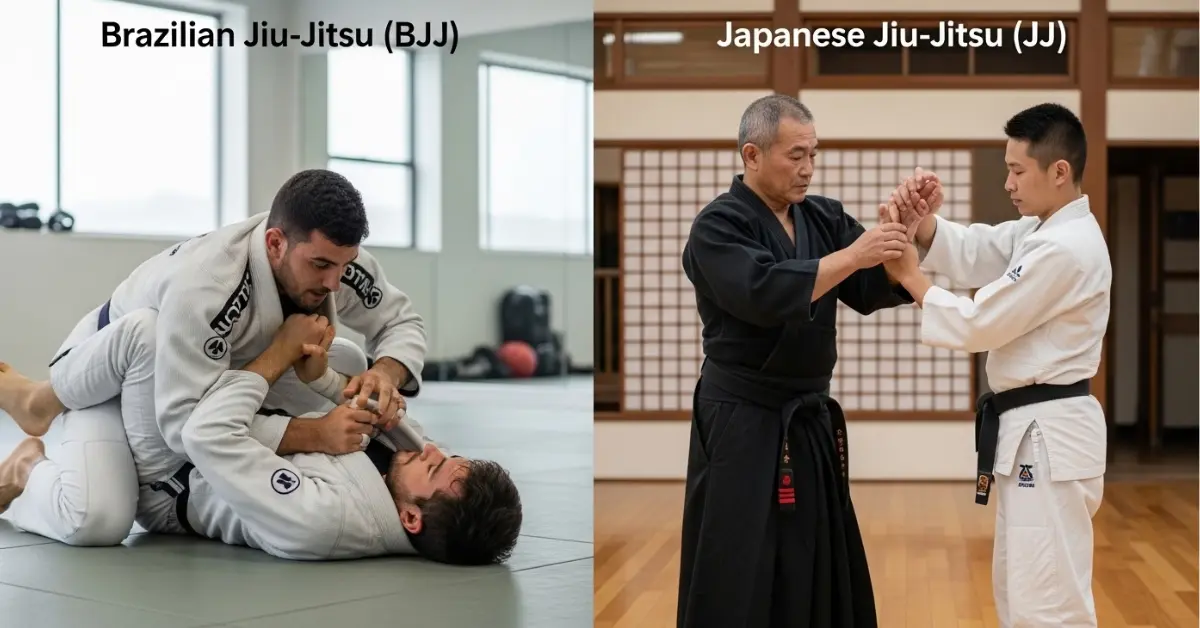
One day, two friends joined a martial arts class. One said, “I learn Brazilian Jiu-Jitsu.” The other said, “I am learning Japanese Jujutsu.” Their teacher smiled because many people do not know the difference between BJJ and JJ. At first, the moves looked the same. Both wore white uniforms and belts. But soon, the teacher showed the difference between BJJ and JJ. One friend practiced mostly on the ground. The other practiced throws and even simple strike defense. Learning the difference between BJJ and JJ helps students pick the right class. When you understand the difference between BJJ and JJ, you know what skills you are building.
Key Difference Between the Both
Brazilian Jiu-Jitsu (BJJ) mostly teaches ground fighting and submissions. Japanese Jujutsu (JJ) teaches throws, locks, strikes, and self-defense moves.
Why Is It Important to Know the Difference?
It is important because children and adults may have different goals. Some want to compete in sports. Some want to learn traditional self-defense. In society, both arts teach respect, discipline, and confidence. Knowing the difference helps you choose the right training.
Pronunciation (US & UK)
- Brazilian Jiu-Jitsu (BJJ) US: bruh-ZIL-yun joo-JIT-soo UK: bruh-ZIL-yun joo-JIT-soo
- Japanese Jujutsu (JJ) US: joo-JUT-soo UK: joo-JOOT-soo
Now, let’s look at the difference in simple points.
Difference Between BJJ and JJ
1. Place of Origin
- BJJ started in Brazil. Example 1: It became famous in sports events. Example 2: Many athletes train in Brazil and the USA.
- JJ started in Japan long ago. Example 1: Samurai used it. Example 2: It is part of Japanese history.
2. Main Focus
- BJJ focuses on ground fighting. Example 1: Pinning someone safely. Example 2: Using chokes.
- JJ focuses on standing and ground fighting. Example 1: Throwing an opponent. Example 2: Using wrist locks.
3. Strikes
- BJJ does not teach punches and kicks in sport class. Example 1: No punching in tournaments. Example 2: Only grappling.
- JJ may teach simple strikes. Example 1: Blocking punches. Example 2: Basic hitting moves.
4. Competition
- BJJ has many competitions. Example 1: Students win medals. Example 2: Points decide the winner.
- JJ has fewer competitions. Example 1: Demonstrations. Example 2: Practice for self-defense.
5. Weapons
- BJJ does not teach weapon defense. Example 1: No stick training. Example 2: No sword practice.
- JJ may teach weapon defense. Example 1: Learning how to escape safely. Example 2: Practicing safe disarms.
6. Training Style
- BJJ practices “rolling” (live practice). Example 1: Timed rounds. Example 2: Friendly sparring.
- JJ practices set moves. Example 1: Step-by-step drills. Example 2: Learning forms.
7. History
- BJJ is about 100 years old. Example 1: Modern sport. Example 2: Used in MMA.
- JJ is hundreds of years old. Example 1: Samurai art. Example 2: Traditional schools.
8. Goal
- BJJ’s goal is to submit the opponent. Example 1: Armbar. Example 2: Triangle choke.
- JJ’s goal is to defend and escape. Example 1: Throw and run. Example 2: Quick control move.
9. Popularity
- BJJ is very popular worldwide. Example 1: Many gyms. Example 2: Seen in MMA.
- JJ is less common. Example 1: Traditional dojos. Example 2: Cultural programs.
10. Style
- BJJ is sporty and modern. Example 1: Matches with rules. Example 2: Points system.
- JJ is traditional and formal. Example 1: Bowing ceremonies. Example 2: Old techniques.
Nature and Behaviour
BJJ is competitive and active. Students test skills in friendly matches.
JJ is calm and traditional. Students follow strict rules and respect old customs.
Why Are People Confused?
People get confused because both names sound the same. Both wear similar uniforms and belts. Also, BJJ came from Japanese Jujutsu, so they share some moves.
Table: Difference and Similarity
PointBJJJJSame ThingOriginBrazilJapanMartial artFocusGroundStand & GroundGrapplingStrikesNoYesSelf-defenseWeaponsNoYesBeltsStyleSportyTraditionalDiscipline
Which Is Better?
BJJ is better if you want to join competitions or learn ground control. It is great for sport and fitness.
JJ is better if you want to learn traditional self-defense and history. It teaches more types of moves, including defense from strikes.
Metaphors and Similes
- “He solved the problem like BJJ calm and smart.”
- “She reacted like JJ quickly and strongly.”
Connotative Meaning
- BJJ: Positive (smart, strong, modern)
- JJ: Positive (respectful, traditional, disciplined)
Both have good meanings.
Idioms or Sayings
- “Use your brain over strength.” (Like BJJ) Example: In exams, use the brain over strength.
- “Stay balanced.” (Like JJ) Example: Stay balanced in hard times.
Books
- Mastering Jujitsu – Sports guide, Renzo Gracie, 2003
Movies
- Redbelt – 2008, USA
- Jiu Jitsu – 2020, USA
5 FAQs
1. Are BJJ and JJ the same? No, they are different styles.
2. Which one is older? Japanese Jujutsu is older.
3. Does BJJ have punches? No, not in sport class.
4. Can kids learn both? Yes, many schools teach kids.
5. Which is better for sport? BJJ is better for sport competitions.
How Both Help Our Surroundings
Both teach respect, self-control, and safety. They help stop bullying and build confidence. They also keep people healthy and active.
Final Words
BJJ is modern and sporty. JJ is traditional and historic. Both are strong and helpful martial arts.
Conclusion
The difference between BJJ and JJ is easy to understand when we look closely. BJJ focuses on ground fighting and sport matches. JJ focuses on traditional self-defense with throws and strikes. Both teach respect and discipline. Choosing the right one depends on what you want to learn. No matter which you choose, both are good for your body and mind.

I am a professional English article writer with expertise in creating clear, well-researched, and engaging content. I specialize in writing informative articles that maintain accuracy, strong structure, and a polished tone. My work reflects a deep understanding of grammar, vocabulary, and audience needs. I am committed to delivering high-quality content that communicates ideas effectively and adds value to readers.