The thyroid is a small gland in the neck. It makes hormones that help control the body’s energy.
There are two common thyroid problems:
- Hypothyroidism
- Hyperthyroidism
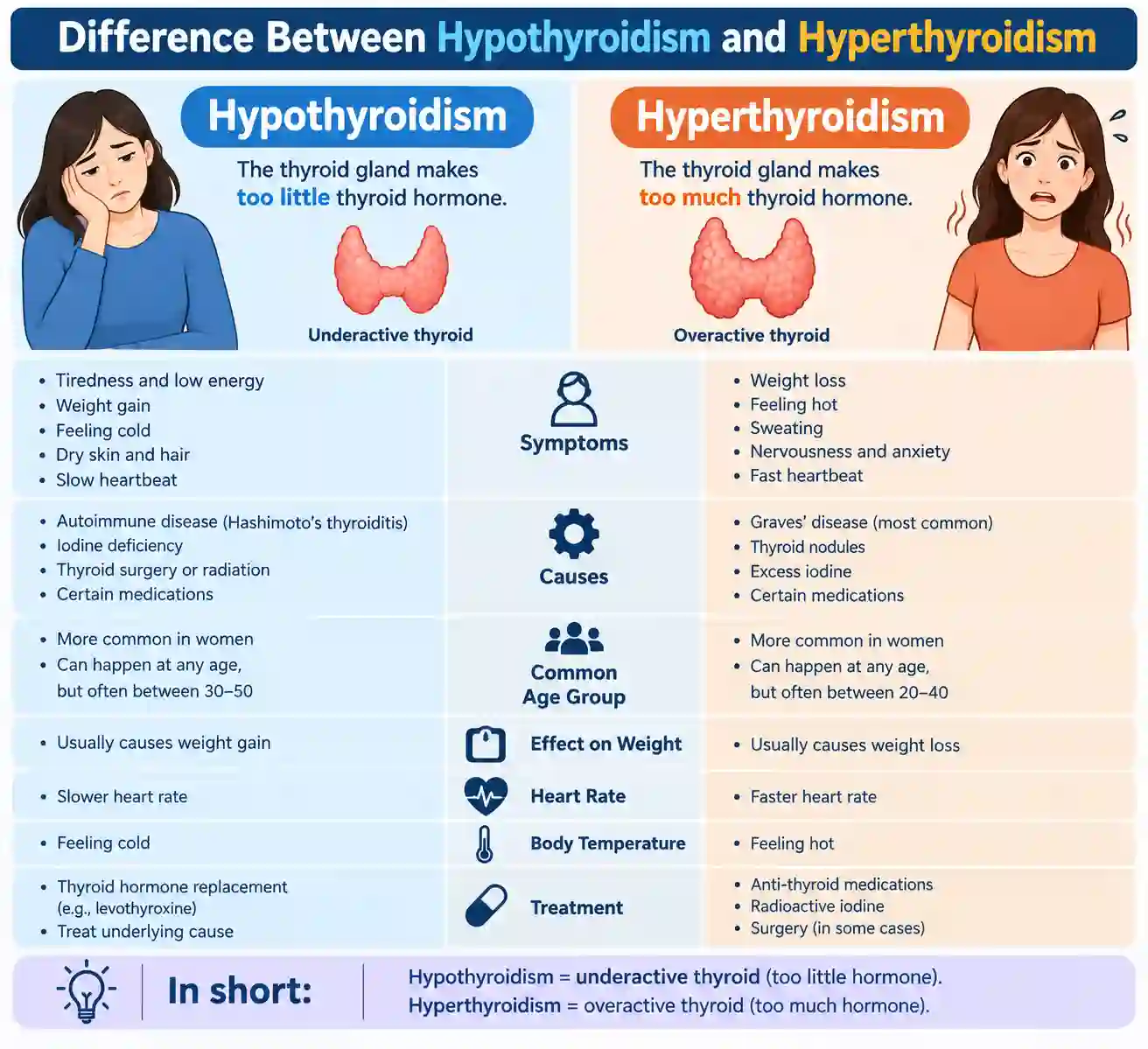
The main difference between hypothyroidism and hyperthyroidism is simple.
Hypothyroidism means the thyroid is too slow.
Hyperthyroidism means the thyroid is too fast.
Both conditions are different. They can also have different symptoms, causes, blood test results, and treatments.
What Is Hypothyroidism?
Hypothyroidism happens when the thyroid does not make enough thyroid hormone.
This can make many body functions slow down.
Common symptoms include:
- Feeling tired
- Weight gain
- Feeling cold
- Dry skin
- Constipation
- Slow heartbeat
- Low energy
- Hair thinning
- Muscle weakness
A common cause is Hashimoto’s disease.
What Is Hyperthyroidism?
Hyperthyroidism happens when the thyroid makes too much thyroid hormone.
This can make many body functions work too fast.
Common symptoms include:
- Weight loss
- Fast heartbeat
- Feeling hot
- Sweating
- Shaky hands
- Feeling nervous
- Trouble sleeping
- More bowel movements
- Muscle weakness
A common cause is Graves’ disease.
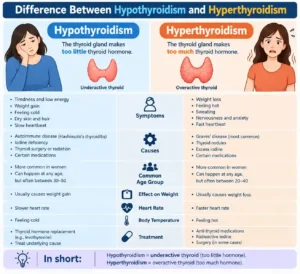
Difference Between Hypothyroidism and Hyperthyroidism Table
Here is a simple difference between hypothyroidism and hyperthyroidism table:
| Feature | Hypothyroidism | Hyperthyroidism |
| Thyroid | Too slow | Too fast |
| Hormones | Too low | Too high |
| Body speed | Slow | Fast |
| Weight | Often goes up | Often goes down |
| Feeling | Cold | Hot |
| Heart rate | Often slow | Often fast |
| Energy | Low | Restless or nervous |
| Sleep | May sleep more | May have trouble sleeping |
| Bowel movements | Less often | More often |
| Skin | Often dry | Often warm or sweaty |
| Common cause | Hashimoto’s disease | Graves’ disease |
| Common treatment | Thyroid hormone | Medicines or other treatment |
Difference Between Hypothyroidism and Hyperthyroidism Symptoms
The symptoms of these two conditions are often opposite.
Hypothyroidism symptoms
A person with hypothyroidism may:
- Feel tired
- Gain weight
- Feel cold
- Have dry skin
- Have constipation
- Feel weak
- Have a slow heartbeat
Hyperthyroidism symptoms
A person with hyperthyroidism may:
- Lose weight
- Feel hot
- Sweat more
- Have a fast heartbeat
- Feel nervous
- Have shaky hands
- Have trouble sleeping
- Have more bowel movements
Symptoms can give clues, but they cannot confirm a thyroid problem. Blood tests are often needed.
Hyperthyroidism and Hypothyroidism T3, T4, TSH Levels
Doctors use blood tests to check thyroid function.
Three important terms are:
- TSH
- T3
- T4
T3 and T4 are thyroid hormones.
TSH helps tell the thyroid how much hormone to make.
In common cases, the blood test may show:
| Condition | TSH | T4 | T3 |
| Hypothyroidism | High | Low | May be low |
| Hyperthyroidism | Low | High | May be high |
These are common patterns. Test results can be different in some people.
A doctor should read the results with the person’s symptoms and health history.
TSH Level in Hypothyroidism and Hyperthyroidism
The TSH level in hypothyroidism and hyperthyroidism is often different.
With common primary hypothyroidism:
TSH is usually high.
With common primary hyperthyroidism:
TSH is usually low.
Why?
When thyroid hormone is low, the body may make more TSH to tell the thyroid to work harder.
When thyroid hormone is high, the body may make less TSH.
How Can You Tell the Difference Between Hypothyroidism and Hyperthyroidism?
You may notice some clear differences.
Hypothyroidism often causes:
- Weight gain
- Feeling cold
- Tiredness
- Slow heartbeat
- Constipation
Hyperthyroidism often causes:
- Weight loss
- Feeling hot
- Sweating
- Fast heartbeat
- Nervousness
- Shaking
This can help you understand how to tell the difference between hypothyroidism and hyperthyroidism.
But symptoms alone are not enough. A blood test can help find the real cause.
20 Distinguish Between Hyperthyroidism and Hypothyroidism
Here are 20 distinguish between hyperthyroidism and hypothyroidism points in simple words:
- Hypothyroidism means low thyroid activity.
- Hyperthyroidism means high thyroid activity.
- Hypothyroidism has too little thyroid hormone.
- Hyperthyroidism has too much thyroid hormone.
- Hypothyroidism may cause weight gain.
- Hyperthyroidism may cause weight loss.
- Hypothyroidism may make you feel cold.
- Hyperthyroidism may make you feel hot.
- Hypothyroidism may cause a slow heartbeat.
- Hyperthyroidism may cause a fast heartbeat.
- Hypothyroidism may cause constipation.
- Hyperthyroidism may cause more bowel movements.
- Hypothyroidism may cause dry skin.
- Hyperthyroidism may cause sweating.
- Hypothyroidism may cause low energy.
- Hyperthyroidism may cause restlessness.
- Hashimoto’s disease can cause hypothyroidism.
- Graves’ disease can cause hyperthyroidism.
- Hypothyroidism is often treated with thyroid hormone medicine.
- Hyperthyroidism may need medicine, radioactive iodine, or surgery.
Treatment of Hypothyroidism and Hyperthyroidism
The treatment of hypothyroidism and hyperthyroidism is different.
This is because the two conditions work in opposite ways.
Treatment for Hypothyroidism
Hypothyroidism is often treated with a medicine called levothyroxine.
It replaces the thyroid hormone that the body does not make enough of.
Doctors may use blood tests to check if the medicine dose is right.
Treatment for Hyperthyroidism
Hyperthyroidism can be treated in different ways.
Treatment may include:
- Medicines
- Radioactive iodine
- Surgery
The treatment depends on the cause and the person’s health.
Difference Between Hypothyroidism and Hashimoto’s
The difference between hypothyroidism and Hashimoto’s is important.
Hypothyroidism is a condition where the thyroid does not make enough hormone.
Hashimoto’s disease is an autoimmune disease. It happens when the immune system attacks the thyroid.
Hashimoto’s can cause hypothyroidism.
So, they are not the same thing.
Hashimoto’s can be a cause of hypothyroidism.
Which Is Worse: Hyperthyroidism or Hypothyroidism?
Many people ask, “Which is worse, hyperthyroidism or hypothyroidism?”
There is no simple answer.
Both can cause health problems if they are not treated.
The risk depends on:
- How severe the condition is
- What caused it
- How long it lasts
- The person’s age
- Other health problems
- Whether it is treated
Both conditions should be checked and treated when needed.
Difference Between Hypothyroidism and Hyperthyroidism and Weight
Weight changes are common with thyroid problems.
With hypothyroidism, a person may gain weight.
With hyperthyroidism, a person may lose weight.
However, weight change can have many causes.
You cannot diagnose a thyroid problem from weight alone.
Difference in Heart Rate
Hypothyroidism can cause a slower heart rate.
Hyperthyroidism can cause a faster heart rate.
Some people with hyperthyroidism may also have an irregular heartbeat.
A very fast or irregular heartbeat should be checked by a healthcare professional.
Difference in Body Temperature
People with hypothyroidism may feel cold more often.
People with hyperthyroidism may feel hot more often.
This is because thyroid hormones affect how the body uses energy.
Difference in Energy
Hypothyroidism may make you feel tired and slow.
Hyperthyroidism may make you feel restless or nervous.
Even people with hyperthyroidism can feel tired because the body is working too hard.
Causes of Hypothyroidism
Some common causes include:
- Hashimoto’s disease
- Thyroid surgery
- Some medicines
- Some thyroid treatments
- Low iodine in some areas
A doctor can help find the cause.
Causes of Hyperthyroidism
Common causes include:
- Graves’ disease
- Overactive thyroid nodules
- Thyroid inflammation
- Taking too much thyroid hormone medicine
- Too much iodine in some cases
Can Hypothyroidism Turn Into Hyperthyroidism?
Hypothyroidism does not normally just turn into hyperthyroidism.
However, some thyroid diseases can make hormone levels change over time.
Some people may have high thyroid hormone levels for a time and later have low levels.
Doctors may repeat blood tests when symptoms change.
Is There a Difference Between Hypothyroidism and Hyperthyroidism?
Yes.
There is a clear difference.
Hypothyroidism means the thyroid is underactive.
Hyperthyroidism means the thyroid is overactive.
They can have opposite symptoms and different treatments.
Difference Between Hypothyroidism and Hyperthyroidism in Cats
Cats can also have thyroid problems.
Hyperthyroidism is common in older cats.
It can cause:
- Weight loss
- More hunger
- More thirst
- Restlessness
- Fast heartbeat
Hypothyroidism is rare in cats.
A veterinarian should check a cat with possible thyroid symptoms.
Difference Between Hypothyroidism and Hyperthyroidism in Hindi
In simple Hindi:
Hypothyroidism mein thyroid gland kam hormone banati hai.
Hyperthyroidism mein thyroid gland zyada hormone banati hai.
Hypothyroidism mein weight badh sakta hai aur thand zyada lag sakti hai.
Hyperthyroidism mein weight kam ho sakta hai aur garmi zyada lag sakti hai.
Difference Between Hypothyroidism and Hyperthyroidism PDF
Students may search for a difference between hypothyroidism and hyperthyroidism PDF for study notes.
The main points are:
- Hypothyroidism = thyroid too slow
- Hyperthyroidism = thyroid too fast
- Hypothyroidism = low thyroid hormone
- Hyperthyroidism = high thyroid hormone
- Hypothyroidism = often high TSH
- Hyperthyroidism = often low TSH
- Hypothyroidism = weight gain may happen
- Hyperthyroidism = weight loss may happen
These points can also be used in a PPT, chart, or study notes.
Difference Between Hypothyroidism and Hyperthyroidism Levels
Thyroid levels can help doctors tell the two conditions apart.
In common primary hypothyroidism:
- TSH is high
- T4 is low
In common primary hyperthyroidism:
- TSH is low
- T4 is high
T3 may also be checked.
The exact test pattern depends on the type of thyroid problem.
Frequently Asked Questions
What is the main difference between hypothyroidism and hyperthyroidism?
Hypothyroidism means the thyroid makes too little hormone. Hyperthyroidism means it makes too much hormone.
What is the difference between hypothyroidism and hyperthyroidism symptoms?
Hypothyroidism often causes tiredness, weight gain, and feeling cold. Hyperthyroidism often causes weight loss, sweating, and feeling hot.
What happens to TSH in hypothyroidism?
In common primary hypothyroidism, TSH is usually high.
What happens to TSH in hyperthyroidism?
In common primary hyperthyroidism, TSH is usually low.
Can hypothyroidism cause weight gain?
Yes. Weight gain can happen with hypothyroidism.
Can hyperthyroidism cause weight loss?
Yes. Hyperthyroidism can cause weight loss.
Is Hashimoto’s the same as hypothyroidism?
No. Hashimoto’s is a disease that can cause hypothyroidism.
Can both conditions be treated?
Yes. Both can often be treated. The treatment depends on the cause.
How can you tell the difference between hypothyroidism and hyperthyroidism?
Symptoms can give clues, but blood tests such as TSH and T4 are often needed to confirm the problem.
Final Thoughts
The difference between hypothyroidism and hyperthyroidism is easy to remember.
Hypothyroidism = thyroid too slow.
Hyperthyroidism = thyroid too fast.
Hypothyroidism may cause weight gain, tiredness, and feeling cold.
Hyperthyroidism may cause weight loss, sweating, and feeling hot.
TSH, T3, and T4 blood tests can help doctors check thyroid function.
If you have symptoms of a thyroid problem, talk to a healthcare professional. Do not start or stop thyroid medicine without medical advice.

I am a professional English article writer with expertise in creating clear, well-researched, and engaging content. I specialize in writing informative articles that maintain accuracy, strong structure, and a polished tone. My work reflects a deep understanding of grammar, vocabulary, and audience needs. I am committed to delivering high-quality content that communicates ideas effectively and adds value to readers.