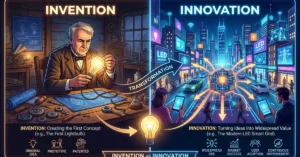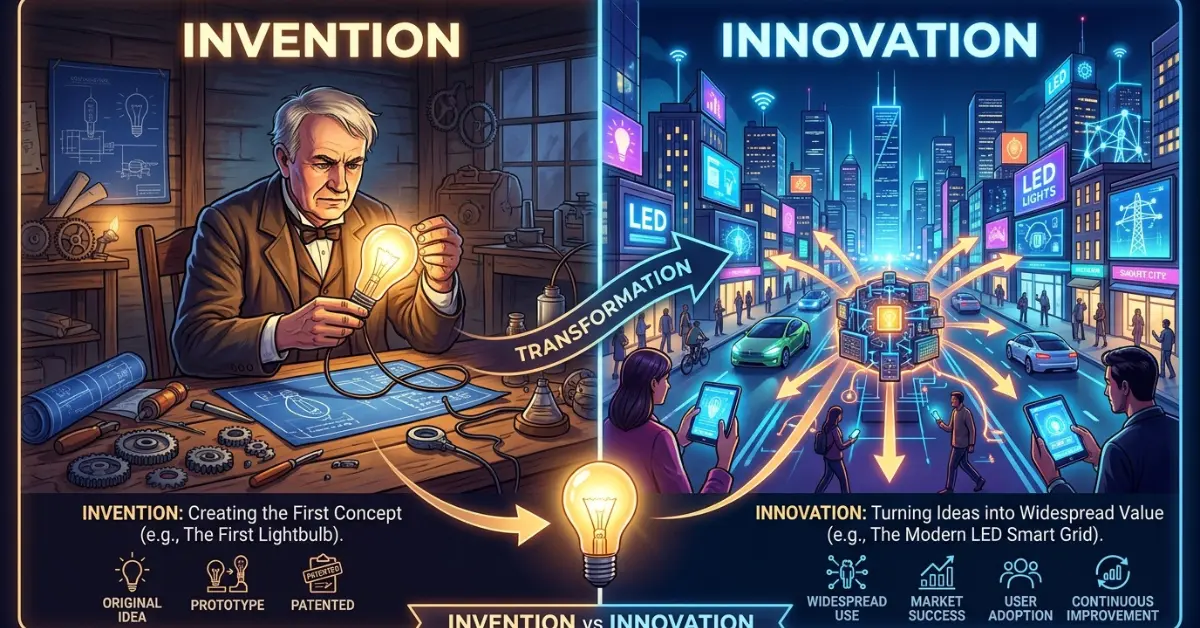
The difference between innovation and invention is simple. Invention means creating something completely new that did not exist before. Innovation means improving or using an existing idea in a better way. In short, invention creates something new, while innovation improves or applies it in a smarter way.
A student once asked, “Is the smartphone an invention or an innovation?” The teacher smiled and said, “It is both in different ways.” This confusion is very common.
The difference between innovation and invention is often mixed up because both involve new ideas. But they are not the same. One is about creating something from nothing. The other is about making something better or more useful.
In this article, you will learn simple meanings of invention and innovation, clear differences, real-life examples, and an easy trick to remember them. Everything is explained in very simple English.
What Is Invention?
An invention is when someone creates something completely new that has never existed before.
It is the first time something is made.
Inventions often solve problems or change how people live.
Example: The light bulb, telephone, and airplane were inventions.
These things did not exist before someone created them.
What Is Innovation?
An innovation is when someone improves an existing idea, product, or process.
It is not always new from scratch. Instead, it makes something better, faster, or easier.
Example: Smartphones are an innovation of old mobile phones.
They improved calling, added internet, camera, and apps.
Key Differences Explained
Creation vs Improvement
Invention is about creating something new. Innovation is about improving what already exists.
Example: A bicycle was invented long ago. Electric bicycles are an innovation.
First Idea vs Better Version
Invention is the first idea. Innovation makes it better.
Example: First telephone = invention Smartphone = innovation
Problem Solving
Both help solve problems, but in different ways.
Invention solves problems by creating something new. Innovation solves problems by upgrading old solutions.
Risk and Effort
Invention usually needs more creativity and risk. Innovation focuses on improvement and efficiency.
Examples
Here are simple real-life examples:
- Invention: Light bulb by Thomas Edison
- Innovation: LED bulbs that save energy
- Invention: First car
- Innovation: Electric and self-driving cars
- Invention: Basic phone
- Innovation: Smartphones with apps
These examples show how ideas grow over time.
Importance of Knowing the Difference
Understanding the difference between innovation and invention helps you think clearly about ideas.
It helps students, business people, and creators understand how new things are made and improved.
It also helps in exams, interviews, and general knowledge.
Benefits of Understanding Innovation vs Invention
- Improves thinking skills
- Helps in creativity
- Builds business understanding
- Clears confusion in learning
- Helps in exams and interviews
- Encourages new ideas
- Improves problem-solving ability
Common Mistakes People Make
Mistake 1: Thinking innovation and invention are the same. They are related but different.
Mistake 2: Calling every new product an invention Some are just improvements.
Mistake 3: Ignoring improvements Innovation is very important in progress.
Real-Life Use
In real life, both invention and innovation are everywhere.
- Scientists create inventions in labs
- Companies improve products through innovation
- Technology grows through both processes
Example: The internet was an invention. Social media apps are innovations built on it.
Easy Trick to Remember the Difference
Think like this:
Invention = Introducing something new Innovation = Improving something old
So, Invention = Start Innovation = Upgrade
Which One Is Better?
Neither is better. Both are important.
Invention starts new ideas. Innovation makes those ideas useful in daily life.
Without invention, there is nothing new. Without innovation, inventions do not improve.
Both work together.
FAQs
1. What is the main difference between innovation and invention?
Invention creates something new. Innovation improves something existing.
2. Is the smartphone an invention or innovation?
It is an innovation of older mobile phones.
3. Can innovation exist without invention?
No, innovation usually builds on inventions.
4. Which comes first, invention or innovation?
Invention comes first.
5. Is every new product an invention?
No, many are innovations of old products.
6. Why are innovation and invention important?
They help improve life and solve problems.
7. Can one person do both?
Yes, many people are both inventors and innovators.
Conclusion
The difference between innovation and invention is simple when you understand the idea behind them. Invention means creating something completely new for the first time. Innovation means improving or upgrading something that already exists.
Both are very important for progress in science, technology, and daily life. Inventions bring new ideas into the world, while innovations make those ideas better and more useful.
When you understand this difference, you can clearly see how the world grows and changes. New ideas start things, and improvements take them forward.

I am a professional English article writer with expertise in creating clear, well-researched, and engaging content. I specialize in writing informative articles that maintain accuracy, strong structure, and a polished tone. My work reflects a deep understanding of grammar, vocabulary, and audience needs. I am committed to delivering high-quality content that communicates ideas effectively and adds value to readers.