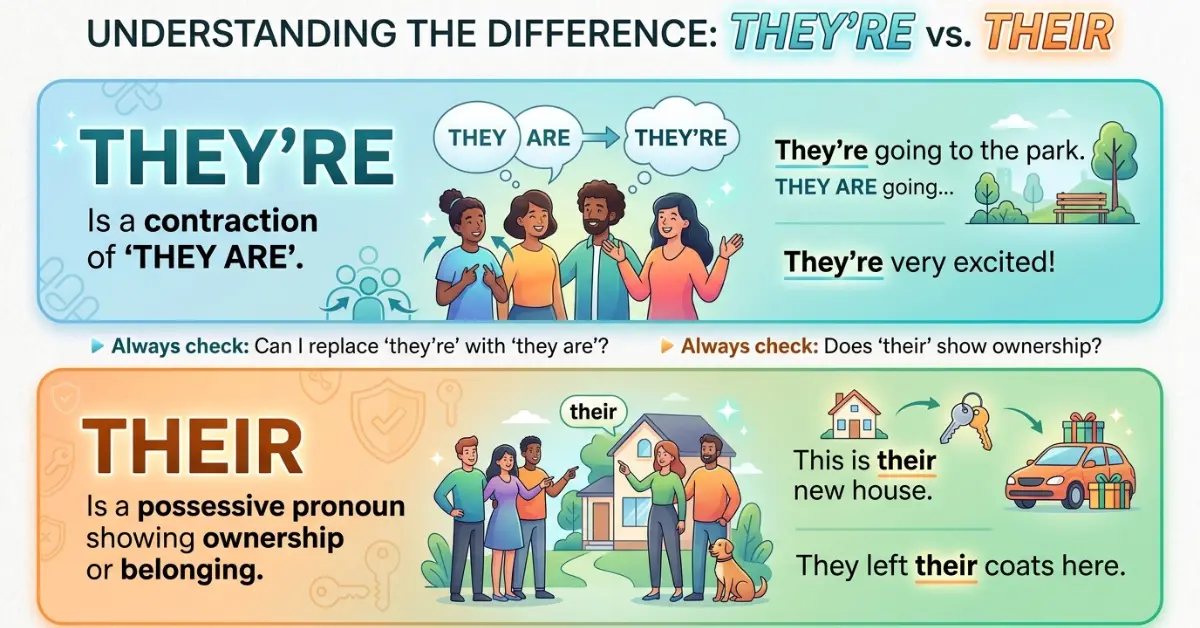
The difference between they’re and their is about meaning and use. They’re means “they are.” Their shows ownership, like something belongs to them. In simple words, they’re = they are, and their = something belongs to them.
A student once wrote, “Their going to school.” The teacher smiled and said, “Close, but not right.” Many learners feel confused with they’re and their because they sound the same.
The difference between they’re and their is simple, but very important. Using the wrong one can change the meaning of your sentence. This mistake is common in writing, messages, and exams.
In this article, you will learn what they’re means, what their means, and how to use each one correctly. You will also see easy examples and a simple trick to remember the difference forever.
What Is They’re?
They’re is a short form (contraction) of they are.
It is used when you want to say “they are” in a shorter way.
Example: They’re going to the park. (They are going to the park.)
What Is Their?
Their shows ownership. It means something belongs to “them.”
It is a possessive word.
Example: Their house is big. (The house belongs to them.)
Key Differences Explained
Meaning
They’re means “they are.” Their shows something belongs to them.
Example: They’re playing. Their ball is red.
Grammar Use
They’re is used with verbs. Their is used before nouns.
Example: They’re eating food. Their food is ready.
Sentence Role
They’re talks about action or condition. Their talks about possession.
Examples
Here are simple real-life examples:
- They’re going to school.
- Their school is big.
- They’re playing cricket.
- Their bat is new.
- They’re watching TV.
- Their TV is broken.
These examples show how meaning changes.
Importance of Knowing the Difference
Knowing the difference between they’re and their helps you write correct English.
It is very important in school, exams, and daily writing. Wrong use can confuse the reader.
Correct grammar makes your writing clear and strong.
Benefits of Understanding They’re vs Their
- Improves writing skills
- Reduces grammar mistakes
- Makes sentences clear
- Helps in exams
- Builds confidence
- Improves communication
- Shows good English knowledge
Common Mistakes People Make
Mistake 1: Using “their” instead of “they’re” Wrong: Their going home Right: They’re going home
Mistake 2: Using “they’re” for ownership Wrong: They’re house is big Right: Their house is big
Mistake 3: Not checking meaning Always check if you mean “they are” or “belongs to them.”
Real-Life Use
In daily life, people use these words in messages, emails, and school work.
- Students use them in writing
- People use them in chats
- Teachers check them in exams
Correct use helps in all these situations.
Easy Trick to Remember the Difference
Try this simple trick:
Replace they’re with “they are.” If the sentence still makes sense, it is correct.
Example: They’re happy → They are happy ✔
For their, think: Their = belongs to them
Which One Is Better?
Neither is better. Both are correct words.
You use they’re when you mean “they are.” You use their when something belongs to them.
The correct choice depends on your sentence.
FAQs
1. What is the main difference between they’re and their?
They’re means “they are,” and their shows ownership.
2. Which is correct: they’re or their?
Both are correct, depending on meaning.
3. How can I check if they’re is correct?
Replace it with “they are.”
4. Can I use their for action?
No, their is only for ownership.
5. Why do people confuse them?
Because they sound the same.
6. Is they’re a short form?
Yes, it is short for “they are.”
7. Which one should I use in a sentence?
Use they’re for action and their for ownership.
Conclusion
The difference between they’re and their is easy once you understand the meaning. They’re means “they are,” while their shows something belongs to them.
This small difference is very important in writing and speaking. Using the correct word makes your sentences clear and correct. It also helps you avoid common mistakes.
With a little practice and the simple trick in this article, you can use both words with confidence. Keep practicing, and you will never mix them up again.

I am Erneest Dowson, an English poet and writer. My work reflects deep emotions, beauty, and themes of love and sadness. I am known for my Professional, lyrical and romantic writing style.