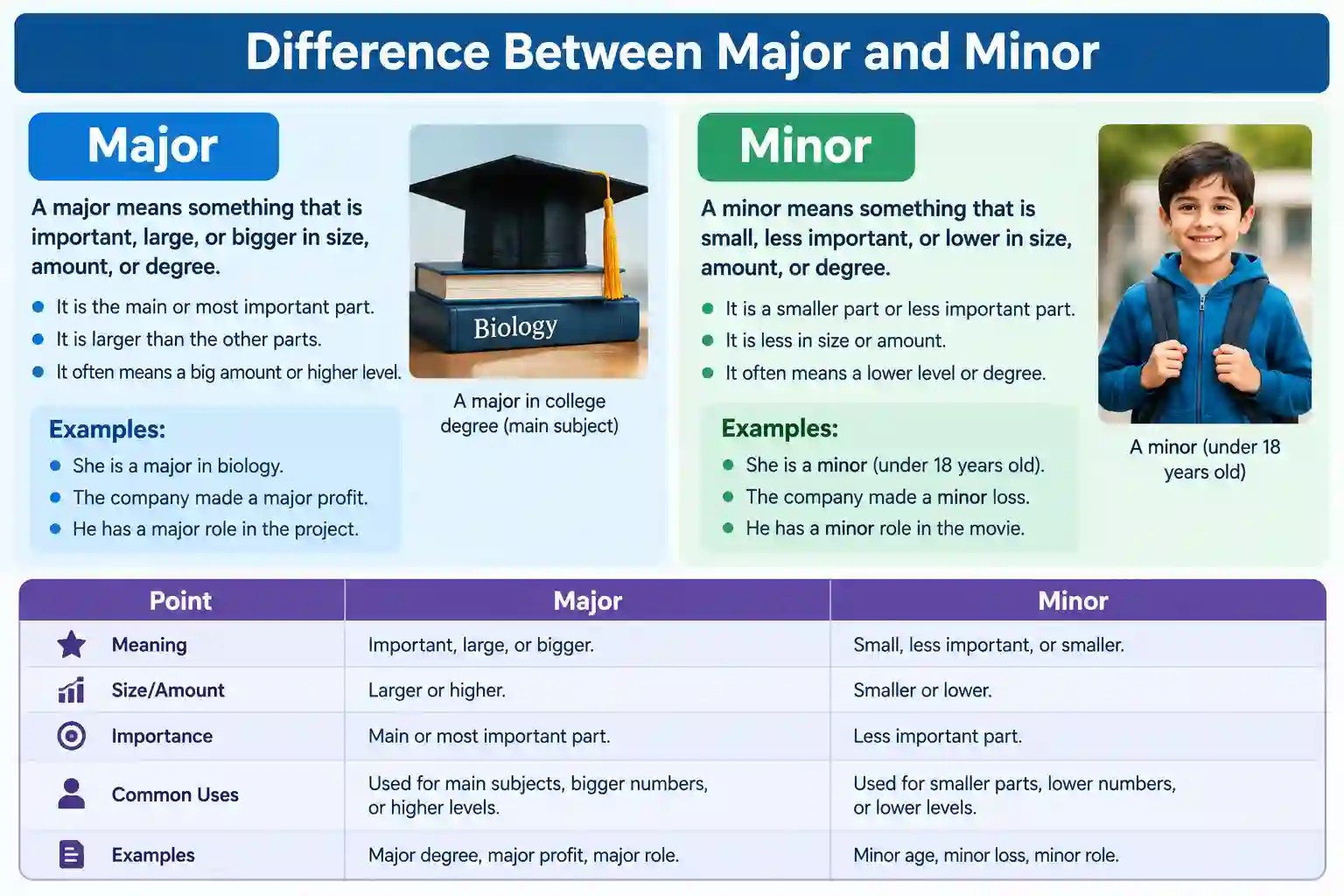
The word major and minor can have different meanings.
It depends on the topic.
For example, in music, major and minor describe scales and chords. In college, a major is the main subject a student studies. A minor is a smaller subject.
In simple words, major often means bigger or main, while minor often means smaller or less main.
Difference Between Major and Minor
The difference between major and minor depends on where the words are used.
| Major | Minor |
| Often means bigger | Often means smaller |
| Can mean main | Can mean less main |
| Major scale | Minor scale |
| Major chord | Minor chord |
| Major arc is longer | Minor arc is shorter |
| Main college subject | Smaller college subject |
Now let us look at the different meanings.
Difference Between Major and Minor Music
The difference between major and minor music is mainly in the notes and sound.
A major key or scale often sounds bright and open.
A minor key or scale often sounds darker or more serious.
For example:
- C major
- A minor
- G major
- E minor
Both major and minor music can have many different feelings.
What Is the Difference Between Major and Minor Music?
Major and minor use different note patterns.
A major scale has a different pattern from a minor scale.
This changes the sound of the music.
Major music may sound happy or bright.
Minor music may sound sad or dark.
But this is not always true. A major song can sound sad, and a minor song can sound happy.
Difference Between Major and Minor Scales
A major scale and a minor scale have different note patterns.
For example:
C Major
C – D – E – F – G – A – B – C
A Minor
A – B – C – D – E – F – G – A
C major and A minor use the same basic notes, but they have a different main note and sound.
Difference Between Major and Minor Chords
The difference between major and minor chords comes from the notes in the chord.
For example:
C major:
C – E – G
C minor:
C – E♭ – G
Only one note changes.
But this gives the chords a different sound.
A major chord often sounds bright.
A minor chord often sounds darker.
Difference Between Major and Minor Keys
A major key and a minor key use different musical patterns.
Examples of major keys are:
- C major
- G major
- D major
Examples of minor keys are:
- A minor
- E minor
- D minor
A major key often has a bright sound.
A minor key often has a darker sound.
Difference Between Major and Minor Piano
The difference between major and minor piano is about scales, keys, and chords.
The piano itself does not have separate major and minor keys.
You use the same piano to play both.
For example:
- C major chord = C, E, G
- C minor chord = C, E♭, G
The notes are close, but the sound is different.
Difference Between Major and Minor Guitar
The difference between major and minor guitar is also about chords, scales, and keys.
A guitar can play both major and minor chords.
For example:
- C major
- C minor
- A major
- A minor
- G major
- G minor
Major chords often sound bright.
Minor chords often sound darker.
Difference Between Major and Minor Notes
People often search for the difference between major and minor notes.
A single note is not usually called major or minor.
The terms are mostly used for:
- Major scales
- Minor scales
- Major chords
- Minor chords
- Major keys
- Minor keys
- Major intervals
- Minor intervals
So, the meaning depends on what part of music you are talking about.
Major and Minor Degree Examples
A scale has scale degrees.
For example, the C major scale is:
- C
- D
- E
- F
- G
- A
- B
The numbers show the position of each note.
The third degree is important when we compare major and minor chords.
For example:
C major: C – E – G
C minor: C – E♭ – G
The third note is lower in the minor chord.
Difference Between Major and Minor Arc
In math and geometry, an arc is part of a circle.
A circle can have a major arc and a minor arc.
A minor arc is the shorter part of the circle.
A major arc is the longer part.
So:
Major arc = longer arc
Minor arc = shorter arc
This is one of the easiest ways to remember the difference.
Difference Between Major and Minor in Chemistry
The difference between major and minor in chemistry can relate to products in a chemical reaction.
A major product is usually the product made in the larger amount.
A minor product is usually made in a smaller amount.
So:
- Major product = main product
- Minor product = smaller product
The exact reason depends on the chemical reaction.
Difference Between Major and Minor in College
The difference between major and minor in college is easy to understand.
A major is the main subject or field a student studies.
A minor is a smaller field of study.
For example:
Major: Computer Science
Minor: Business
The student takes more courses in the major.
The minor gives extra knowledge in another area.
The rules can be different from one college to another.
Difference Between Major and Minor Surgery
The difference between major and minor surgery is usually based on the size and complexity of the operation.
Major surgery is generally a larger or more complex operation.
Minor surgery is generally smaller or less complex.
For example, some small procedures may be called minor surgery, while large operations may be called major surgery.
The exact meaning depends on the medical procedure.
Difference Between Major and Minor Prophets
The difference between major and minor prophets is mainly about the length of their books.
The terms are used for groups of prophetic books in the Bible.
Major Prophets have longer books.
Minor Prophets have shorter books.
The word “minor” does not mean less important.
Examples of Major Prophets include:
- Isaiah
- Jeremiah
- Ezekiel
Examples of Minor Prophets include:
- Hosea
- Joel
- Amos
- Jonah
- Micah
- Malachi
Difference Between Major and Minor Prophets PDF
If you need a simple difference between major and minor prophets PDF, remember:
Major Prophets = longer books
Minor Prophets = shorter books
The list can vary by Bible tradition.
Difference Between Major and Minor Service
The words major service and minor service can be used in different fields.
Usually, a major service means a larger or more important service.
A minor service may mean a smaller service or a less extensive service.
The exact meaning depends on the business or industry using the terms.
10 Easy Differences Between Major and Minor
Here are 10 simple differences:
- Major often means bigger.
- Minor often means smaller.
- Major can mean the main part.
- Minor can mean a smaller part.
- A major scale is different from a minor scale.
- A major chord is different from a minor chord.
- A major arc is longer than a minor arc.
- A college major is the main field of study.
- A college minor is a smaller field of study.
- A major product is often made in a larger amount than a minor product.
How to Remember Major and Minor
A simple trick is:
Major = main or bigger
Minor = smaller or less main
For music, remember that major and minor are different musical patterns.
For geometry:
Major arc = longer
Minor arc = shorter
For college:
Major = main subject
Minor = smaller subject
Are Major and Minor Opposites?
Sometimes they act like opposites.
For example:
- Major arc vs minor arc
- Major surgery vs minor surgery
- Major product vs minor product
But they are not always exact opposites.
In music, major and minor are different types of scales, keys, and chords.
Quick Examples
Here are some easy examples:
Music
C major and A minor
Chords
C major and C minor
Piano
Major and minor chords
Guitar
Major and minor chords
Geometry
Major arc and minor arc
Chemistry
Major product and minor product
College
Major subject and minor subject
Bible
Major Prophets and Minor Prophets
Surgery
Major surgery and minor surgery
FAQs
What’s the difference between major and minor?
Major often means bigger, main, or more important. Minor often means smaller or less main. The exact meaning depends on the topic.
What is the difference between major and minor music?
Major and minor music use different note patterns. Major often sounds bright, while minor often sounds darker.
What is the difference between major and minor chords?
Major and minor chords have different notes. For example, C major is C-E-G, while C minor is C-E♭-G.
What is the difference between major and minor scales?
They have different note patterns. They also have different sounds.
What is the difference between major and minor piano?
Major and minor on piano refer to keys, scales, and chords. The same piano can play both.
What is the difference between major and minor guitar?
A guitar can play both major and minor chords and scales. The notes and sound are different.
What is the difference between major and minor in college?
A major is the main field of study. A minor is a smaller field of study.
What is the difference between major and minor in chemistry?
A major product is usually made in a larger amount. A minor product is usually made in a smaller amount.
What is the difference between a major and minor arc?
A major arc is the longer part of a circle. A minor arc is the shorter part.
What is the difference between major and minor surgery?
Major surgery is generally larger or more complex. Minor surgery is generally smaller or less complex.
What is the difference between major and minor prophets?
Major Prophets have longer books. Minor Prophets have shorter books. “Minor” does not mean less important.
Final Thoughts
The difference between major and minor depends on the topic.
In general, major can mean bigger or main.
Minor can mean smaller or less main.
In music, major and minor describe different scales, keys, and chords.
In geometry, a major arc is longer than a minor arc.
In college, a major is the main field of study, while a minor is a smaller field.
In chemistry, major and minor can describe the amount of products in a reaction.
So, always look at the subject to understand the exact meaning of major and minor.

I am a professional English article writer with expertise in creating clear, well-researched, and engaging content. I specialize in writing informative articles that maintain accuracy, strong structure, and a polished tone. My work reflects a deep understanding of grammar, vocabulary, and audience needs. I am committed to delivering high-quality content that communicates ideas effectively and adds value to readers.