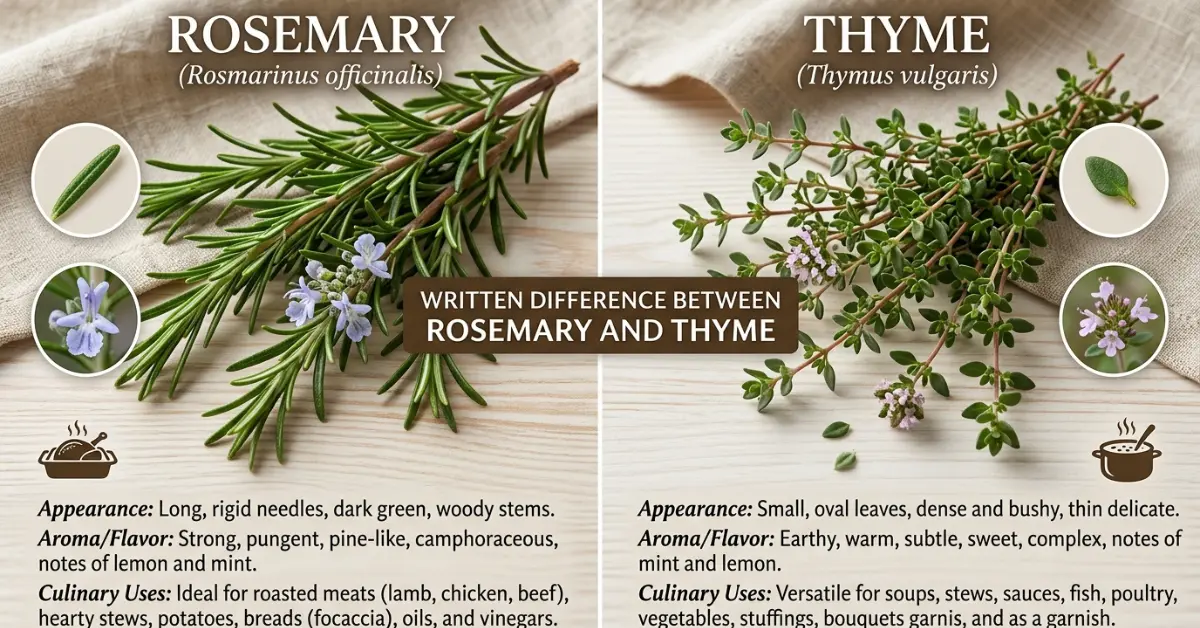
The difference between rosemary and thyme is that rosemary has a strong, woody flavor, while thyme has an earthy taste with soft leaves.
Imagine you are cooking at home. You open a recipe, and it says, “Add rosemary and thyme.” You look at both herbs and think, “Aren’t they the same?” Many people feel this confusion.
The difference between rosemary and thyme is simple, but very important in cooking. Both are popular herbs, and both add flavour to food. But they do not taste the same, and they are not used in the same way.
If you use the wrong one, your dish may not taste right. That is why it is important to understand them clearly. You will learn what rosemary and thyme are, how they are different, where to use them.
What Is Rosemary?
Rosemary is a strong herb with long, thin, needle-like leaves. It looks a bit like a small pine tree branch. The leaves are hard and slightly rough.
This herb has a bold smell. Its taste is strong, woody, and slightly bitter. Because of this strong flavour, you usually use only a small amount.
Rosemary grows on a bush-like plant. It stays green all year and is often used fresh or dried.
People mostly use rosemary when cooking meat. It works very well with chicken, lamb, and beef. It is also used with roasted potatoes.
Example: When you roast chicken in the oven, adding rosemary gives it a deep and rich flavor.
What Is Thyme?
Thyme is a soft herb with very small leaves. The leaves are round or oval and grow on thin stems. They are easy to pull off.
Thyme has a gentle smell. Its taste is light, earthy, and slightly sweet. It is not as strong as rosemary, so it blends well with other flavors.
Thyme grows on a small plant close to the ground. It is often used fresh or dried in many dishes.
People use thyme in soups, vegetables, sauces, and even eggs. It is very flexible and works in many types of food.
Example: When making vegetable soup, thyme adds a soft and warm flavor without being too strong.
Difference Between Rosemary and Thyme
The difference between rosemary and thyme can be understood through their look, taste, and use.
Rosemary has long, needle-like leaves, while thyme has tiny, soft leaves. Rosemary feels hard, while thyme feels delicate.
In taste, rosemary is strong and bold. The theme is light and gentle. Rosemary stands out in a dish, while thyme blends in.
In cooking, rosemary is best for heavy foods like meat and roasted dishes. Thyme is better for light foods like soups, vegetables, and sauces.
Rosemary has a sharp smell. Thyme has a soft and pleasant smell.
Key Differences Explained
Taste
Taste is the biggest difference.
Rosemary has a strong and powerful taste. Even a small amount can change the whole dish.
Thyme has a mild and soft taste. It supports other flavors instead of taking over.
Example: If you add too much rosemary, the food may taste bitter. But thyme is safer because it is not too strong.
Appearance
You can easily tell them apart by looking.
Rosemary leaves are long and thin, like needles. They look sharp and firm.
Thyme leaves are tiny and round. They look soft and simple.
Example: If you see long green needles, it is rosemary. If you see small leaves on thin stems, it is thyme.
Texture
Texture also matters in cooking.
Rosemary leaves are hard and thick. They do not break easily.
Thyme leaves are soft and easy to remove from the stem.
Because of this, people often remove rosemary leaves before eating, but thyme can be left in the dish.
Use in Cooking
Each herb is used in different dishes.
Rosemary is best for:
- Roasted chicken
- Grilled meat
- Potatoes
Thyme is best for:
- Soups
- Vegetables
- Sauces
Example: Use rosemary for heavy meals. Use thyme for light meals.
Smell
The smell is also different.
Rosemary has a strong and fresh smell. It feels sharp and clean.
Thyme has a soft and warm smell. It feels calm and gentle.
Examples
Here are simple real-life examples:
- You cook roasted potatoes → use rosemary for strong flavor
- You make chicken soup → use thyme for soft taste
- You grill meat → rosemary works better
- You cook vegetables → thyme is a better choice
In many kitchens, both herbs are used together. But they are added in the right amount to balance taste.
Importance of Knowing the Difference
Knowing the difference between rosemary and thyme helps you cook better food.
If you use rosemary instead of thyme, your dish may become too strong. If you use thyme instead of rosemary, the dish may feel too light.
This knowledge helps you follow recipes correctly. It also helps you experiment and create your own dishes.
It is useful for students, home cooks, and anyone who loves food.
Benefits of Understanding Rosemary vs Thyme
- Helps you cook tasty food
- Improves flavor balance
- Reduces cooking mistakes
- Builds kitchen confidence
- Helps follow recipes correctly
- Makes dishes more professional
- Improves food knowledge
Common Mistakes People Make
Many people make simple mistakes:
Mistake 1: Thinking both herbs are the same They are different in taste and use.
Mistake 2: Using too much rosemary It is strong and can overpower food.
Mistake 3: Using thyme for strong dishes Thyme may not give enough flavor in heavy meals.
Mistake 4: Not checking the recipe Each herb is used for a reason.
Real-Life Use
In real life, both herbs are used in daily cooking.
At home, people use rosemary for roasting meat. Restaurants often use it for grilled dishes.
Thyme is used in soups, sauces, and vegetables. It is very common in everyday meals.
Chefs use both herbs carefully to create balanced flavors.
Even in simple kitchens, these herbs can change the taste of food in a big way.
Easy Trick to Remember the Difference
Here is a simple trick:
Rosemary = Rough and strong Thyme = Tiny and soft
So, Rosemary → strong dishes Thyme → light dishes
This easy idea helps you remember quickly.
Which One Is Better?
There is no “better” herb. Both are useful in different ways.
If you want a strong flavor, choose rosemary. If you want a soft flavor, choose thyme.
The best choice depends on your dish.
For heavy meals, rosemary is better. For light meals, thyme is better.
FAQs
1. What is the main difference between rosemary and thyme?
Rosemary is strong and woody, while thyme is mild and earthy.
2. Can I use thyme instead of rosemary?
Yes, but the taste will be lighter.
3. Which herb is stronger?
Rosemary is stronger than thyme.
4. Why do people confuse rosemary and thyme?
Because both are green herbs used in cooking.
5. Can I use both together?
Yes, they can be used together in some recipes.
6. Which is better for soup?
Thyme is better for soup.
7. Which one should I choose?
Choose based on your dish and flavor needs.
Conclusion
The difference between rosemary and thyme is easy when you understand their taste, look, and use. Rosemary is strong, bold, and best for heavy dishes like meat and roasting. Thyme is soft, gentle, and perfect for soups, vegetables, and light meals.
Both herbs are important in cooking, but they are not the same. Using the right one can make your food taste much better. Once you understand this difference, you can cook with more confidence and enjoy better flavors every day.
Keep practising, try both herbs in your kitchen, and soon you will know exactly which one to use without thinking twice.

I am Erneest Dowson, an English poet and writer. My work reflects deep emotions, beauty, and themes of love and sadness. I am known for my Professional, lyrical and romantic writing style.