The difference between diploid and haploid is very simple.
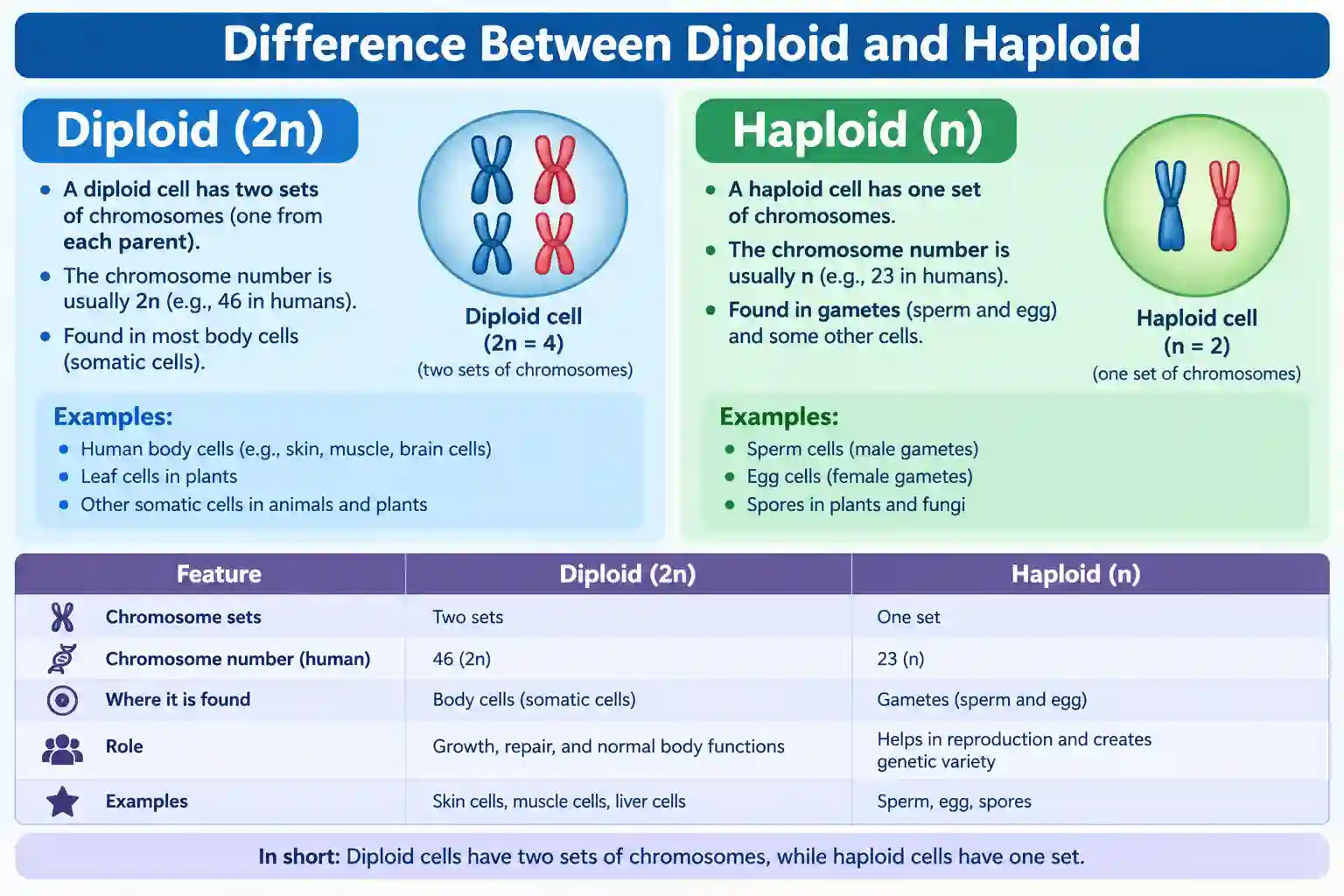
A diploid cell has two sets of chromosomes.
A haploid cell has one set of chromosomes.
In humans, a diploid cell has 46 chromosomes.
A haploid cell has 23 chromosomes.
Both types of cells are important.
What Is Diploid?
A diploid cell has two sets of chromosomes.
It is written as 2n.
In humans:
2n = 46 chromosomes
Most cells in the human body are diploid.
Examples include:
- Skin cells
- Muscle cells
- Liver cells
- Bone cells
- Many other body cells
A diploid cell has chromosome pairs.
One chromosome in each pair comes from the mother.
The other comes from the father.
What Is Haploid?
A haploid cell has one set of chromosomes.
It is written as n.
In humans:
n = 23 chromosomes
Sperm and egg cells are haploid.
They have only one chromosome from each pair.
Haploid cells are important for reproduction.
Difference Between Diploid and Haploid Cells
The main difference between diploid and haploid cells is the number of chromosome sets.
| Diploid | Haploid |
| Two chromosome sets | One chromosome set |
| Written as 2n | Written as n |
| 46 chromosomes in humans | 23 chromosomes in humans |
| Most body cells | Sperm and egg cells |
| Has chromosome pairs | Has one chromosome from each pair |
| Helps with growth and repair | Helps with reproduction |
Difference Between Diploid and Haploid Chromosomes
The difference between diploid and haploid chromosomes is the number of chromosome sets.
A diploid cell has two sets.
A haploid cell has one set.
For humans:
Diploid = 46 chromosomes
Haploid = 23 chromosomes
So, the haploid number is half of the diploid number.
Number of Chromosomes in Haploid and Diploid
The number of chromosomes in haploid and diploid cells can be different in different living things.
In humans:
- Diploid number = 46
- Haploid number = 23
The diploid number is written as 2n.
The haploid number is written as n.
Difference Between Haploid and Diploid With Example
Here is a simple example.
A human skin cell is diploid.
It has 46 chromosomes.
A human sperm cell is haploid.
It has 23 chromosomes.
A human egg cell is also haploid.
It has 23 chromosomes.
So:
Skin cell = Diploid = 46
Sperm cell = Haploid = 23
Egg cell = Haploid = 23
Haploid and Diploid Examples
Diploid Examples
Some diploid cells are:
- Skin cells
- Muscle cells
- Liver cells
- Bone cells
- Most body cells
Haploid Examples
Some haploid cells are:
- Sperm cells
- Egg cells
- Other sex cells
Where Are Haploid and Diploid Cells Found?
Many people ask where are haploid and diploid cells found.
Diploid cells are found in most parts of the human body.
They are found in:
- Skin
- Muscles
- Liver
- Bones
- Organs
Haploid cells are found in the reproductive system.
In humans, sperm cells are made in the testes.
Egg cells develop in the ovaries.
Both sperm and egg cells are haploid.
Haploid vs Diploid Meiosis
Meiosis is a special type of cell division.
It makes haploid cells.
A diploid cell starts the process.
The chromosome number is cut in half.
For example:
46 → Meiosis → 23
This is important for sexual reproduction.
Meiosis helps make sperm and egg cells.
Diploid vs Haploid Mitosis
Mitosis is another type of cell division.
It makes new cells.
The new cells usually have the same chromosome number as the original cell.
For example:
Diploid cell → Mitosis → Diploid cells
A human diploid cell has 46 chromosomes.
After normal mitosis, the new cells also have 46 chromosomes.
Mitosis helps the body:
- Grow
- Repair the body
- Replace old cells
- Make new cells
Difference Between Diploid and Haploid Nucleus
The difference between diploid and haploid nucleus is the number of chromosomes inside the nucleus.
A diploid nucleus has two chromosome sets.
A haploid nucleus has one chromosome set.
In humans:
Diploid nucleus = 46 chromosomes
Haploid nucleus = 23 chromosomes
The nucleus contains the cell’s DNA.
Difference Between Diploid and Haploid Gametes
A gamete is a sex cell.
Human sperm and egg cells are gametes.
They are haploid.
A sperm has 23 chromosomes.
An egg has 23 chromosomes.
When they join, they make a diploid cell.
23 + 23 = 46
This new cell is called a zygote.
Diploid and Haploid Homologous Chromosomes
Diploid cells have pairs of homologous chromosomes.
These are matching chromosome pairs.
One comes from the mother.
One comes from the father.
Haploid cells have only one chromosome from each pair.
This is an important difference between diploid and haploid cells in terms of homologous chromosomes.
Difference Between Diploid and Haploid Organisms
The words diploid and haploid can also describe organisms.
A diploid organism has a main life stage with two chromosome sets.
A haploid organism has a main life stage with one chromosome set.
Humans are mainly diploid organisms.
Some plants, fungi, and other living things can have important haploid life stages.
Difference Between Diploid and Haploid in Class 10
For class 10 biology, remember this simple rule:
Diploid = two sets
Haploid = one set
In humans:
Diploid = 46 chromosomes
Haploid = 23 chromosomes
Most body cells are diploid.
Sex cells are haploid.
Meiosis makes haploid cells.
Fertilization brings two haploid cells together.
Difference Between Diploid and Haploid Number
The diploid number is written as 2n.
The haploid number is written as n.
For humans:
2n = 46
n = 23
If an organism has a haploid number of 10, its diploid number is 20.
This is because diploid means two sets.
Difference Between Diploid and Haploid Parthenogenesis
Parthenogenesis is a type of reproduction.
In this process, an egg can develop without normal fertilization by sperm.
Different organisms can have different types of parthenogenesis.
Some can produce haploid offspring.
Some can produce diploid offspring.
So, parthenogenesis does not always produce the same chromosome number.
How to Tell the Difference Between Diploid and Haploid
You can look at the number of chromosome sets.
If there is:
One set → Haploid
Two sets → Diploid
For humans:
23 → Haploid
46 → Diploid
This is the easiest way to remember the difference.
What Is the Main Difference Between Diploid and Haploid Cells?
The main difference is the number of chromosome sets.
A diploid cell has two sets.
A haploid cell has one set.
That is the most important point.
What Is the Difference Between Diploid and Haploid?
The difference between diploid and haploid is that diploid cells have two sets of chromosomes, while haploid cells have one set.
In humans, diploid cells have 46 chromosomes.
Haploid cells have 23 chromosomes.
10 Differences Between Diploid and Haploid
Here are 10 simple differences:
- Diploid cells have two chromosome sets.
- Haploid cells have one chromosome set.
- Diploid is written as 2n.
- Haploid is written as n.
- Human diploid cells have 46 chromosomes.
- Human haploid cells have 23 chromosomes.
- Most body cells are diploid.
- Sperm and egg cells are haploid.
- Diploid cells have homologous chromosome pairs.
- Haploid cells are important for sexual reproduction.
Diploid and Haploid Similarities
Diploid and haploid cells are different, but they also have some things in common.
Both:
- Have DNA
- Have chromosomes
- Carry genetic information
- Are living cells
- Are important for life
The biggest difference is the number of chromosome sets.
Diploid vs Haploid Table
| Feature | Diploid | Haploid |
| Sets | 2 | 1 |
| Symbol | 2n | n |
| Human number | 46 | 23 |
| Common examples | Body cells | Sperm and egg |
| Chromosome pairs | Yes | No |
| Main role | Growth and body work | Reproduction |
| Made by meiosis | No | Yes |
| Used in fertilization | Forms the new body | Joins with another haploid cell |
FAQs
What is the difference between diploid and haploid cells?
Diploid cells have two sets of chromosomes. Haploid cells have one set.
What is the difference between diploid and haploid chromosomes?
Diploid cells have two chromosome sets. Haploid cells have one chromosome set.
What is the difference between diploid and haploid number of chromosomes?
The diploid number is two sets. The haploid number is one set.
In humans, the numbers are 46 and 23.
What are examples of diploid cells?
Skin cells, muscle cells, and liver cells are examples of diploid cells.
What are examples of haploid cells?
Sperm and egg cells are examples of haploid cells.
Where are haploid and diploid cells found?
Diploid cells are found in most body tissues. Haploid cells such as sperm and eggs are found in the reproductive system.
What is the difference between haploid and diploid in meiosis?
Meiosis starts with a diploid cell and makes haploid cells. The chromosome number is reduced by half.
What is the difference between diploid and haploid gametes?
Human gametes are haploid. Sperm and egg cells have 23 chromosomes. Diploid cells have 46 chromosomes.
What is the difference between diploid and haploid organisms?
A diploid organism has a main life stage with two chromosome sets. A haploid organism has a main life stage with one chromosome set.
What is the difference between diploid and haploid nucleus?
A diploid nucleus has two chromosome sets. A haploid nucleus has one chromosome set.
What is the difference between diploid and haploid cells in terms of homologous chromosomes?
Diploid cells have homologous chromosome pairs. Haploid cells have one chromosome from each pair.
How do you tell the difference between diploid and haploid?
Check the chromosome sets. One set means haploid. Two sets mean diploid.
What is the main difference between diploid and haploid cells?
The main difference is the number of chromosome sets. Diploid has two. Haploid has one.
Final Thoughts
The difference between diploid and haploid is easy to remember.
Diploid = 2 sets = 2n
Haploid = 1 set = n
In humans, diploid cells have 46 chromosomes.
Haploid cells have 23 chromosomes.
Most body cells are diploid.
Sperm and egg cells are haploid.
Meiosis makes haploid cells.
Fertilization joins two haploid cells and makes a new diploid cell.
So, remember:
Two sets = Diploid
One set = Haploid

I am a professional English article writer with expertise in creating clear, well-researched, and engaging content. I specialize in writing informative articles that maintain accuracy, strong structure, and a polished tone. My work reflects a deep understanding of grammar, vocabulary, and audience needs. I am committed to delivering high-quality content that communicates ideas effectively and adds value to readers.